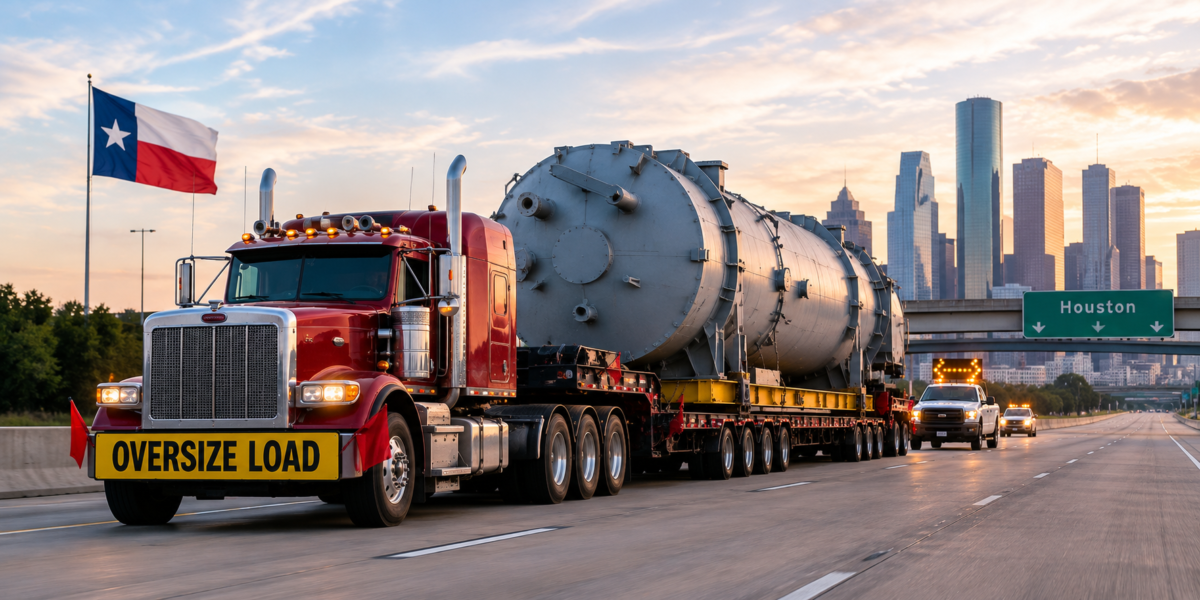
How Do Texas Oversize and Superload Permits Work for Houston Heavy Hauls?
Texas oversize and overweight permits come from the TxDMV: single-trip permits for loads beyond 8 feet 6 inches wide, 14 feet high, or 80,000 pounds, and superload permits with engineering review for the heaviest hauls. Carriers file them, not shippers.
The Paperwork That Moves the Biggest Loads
Houston moves some of the heaviest freight in the country. Drilling rigs roll out to the Permian, transformers head to substations, project cargo comes off ships at Port Houston bound for refineries and wind farms. None of it moves an inch on public roads until the permits are right, and getting permits wrong means a truck parked on the shoulder, fines, and a project schedule in tatters.
The good news for shippers: permits are the carrier’s job, not yours. At First Class Trucking, we file Texas permits, arrange escorts, and plan routes as part of every heavy haul quote. But understanding how the system works helps you plan realistic timelines, so this guide walks through the whole structure: legal limits, permit types, superloads, escorts, and what it all costs in time and money.
When Does a Load Need a Permit in Texas?
A load needs a Texas permit the moment it exceeds legal limits: 8 feet 6 inches wide, 14 feet high, 59 feet of semitrailer length, or 80,000 pounds gross vehicle weight. Cross any one line and the permit requirement kicks in.
These limits apply to the whole combination, truck, trailer, and cargo together, and they’re measured as loaded, not as you hoped it would load. A transformer that fits the width limit on paper but sits 2 inches proud of the deck edge after securement is an oversize load. A ‘standard’ heavy haul that creeps past 80,000 pounds with fuel and equipment aboard needs a Texas overweight permit, even if every dimension is legal. Weight, width, height, and length are judged independently, so a load can need a permit on one axis or all four at once.
| Dimension | Texas Legal Limit | Beyond the Limit |
|---|---|---|
| Width | 8 feet 6 inches | Oversize permit; escorts required at wider thresholds |
| Height | 14 feet | Oversize permit; route checked against bridge clearances |
| Semitrailer length | 59 feet | Oversize permit; longer combinations face route restrictions |
| Gross weight | 80,000 pounds | Texas overweight permit; axle spacing and weights scrutinized |
One nuance worth knowing: Texas treats non-divisible loads, things that physically can’t be broken down without destroying their function, very differently from divisible ones. A bulldozer is non-divisible and permit-eligible. A pile of steel beams that could have shipped on two trucks is divisible, and no permit will save you. Permits exist for loads that can’t be made legal, not for loads you didn’t feel like splitting.
TxDMV Oversize Permits: Types and How They’re Issued
The TxDMV oversize permit system offers three main options: single-trip permits for one-off moves, annual envelope permits for recurring loads within set dimensions, and superload permits for the extreme end. Most are filed online and single-trips often issue the same day.
Single-trip permits cover one specific load on one specific route over a set number of days. For a Houston shipper with an occasional oversize piece, this is the workhorse: your carrier files the dimensions, weight, axle configuration, and route through the TxDMV’s online system, and routine applications typically come back within hours to a couple of business days.
Annual permits suit operations shipping similar oversize freight repeatedly. Instead of filing per move, the carrier holds an envelope permit covering defined dimension and weight ranges, which cuts lead time to zero for anything inside the envelope. Manufacturers and energy companies running regular project cargo out of Houston usually end up here.
A critical detail: the permit belongs to the carrier and the specific equipment moving the load, which is why shippers don’t file these themselves. When you book heavy haul with us, our oversized load services team handles the filing, the route, and the escorts as one package, and the permit cost appears as a line item in your quote, not a surprise.
What Makes a Load a Superload in Texas?
A superload in Texas is a permit load so extreme, generally above roughly 200,000 pounds gross or beyond standard oversize dimensions, that it triggers engineering review instead of routine approval. Superload permits in Texas take days to weeks, not hours.
At superload scale, the permit stops being paperwork and becomes a project. The TxDMV and TxDOT may require bridge analysis along the entire route, a physical route survey with a height pole, coordination with utility companies to lift lines, and detailed axle-load calculations proving the pavement and structures can take it. Law enforcement escorts can enter the picture. The timeline stretches to two to four weeks or more for genuinely extreme moves, and the route you’re approved for may not be the route you wanted.
The practical advice for shippers: bring your carrier into the conversation the moment you know the load’s final dimensions and weight, not after the fabrication date is set. A superload’s permit clock doesn’t care about your project deadline, and the carriers who move these routinely know which questions TxDMV will ask before they ask them.
Escorts, Curfews, and Route Rules on Houston Roads
Texas escort rules scale with size: wider loads need front and rear escort cars, taller loads may need height-pole vehicles, and the largest moves need law enforcement. Houston adds metro curfews that keep oversize loads off the roads during rush hours.
Escort thresholds in Texas generally kick in as width climbs past about 14 feet, with two escorts common beyond that, and height-pole cars for loads approaching overhead clearances. These aren’t suggestions written into the permit; they’re conditions of it, and running without a required escort voids the permit entirely. The escort’s job is real: they run ahead measuring clearances, manage traffic at tight spots, and give the driver eyes the load geometry stole.
Houston’s curfew rules catch more schedules than any other single factor. Oversize loads face movement restrictions during morning and evening rush hours in the metro, plus night-movement limits and holiday blackouts, which means a two-day haul across Texas can take three calendar days once legal driving windows do their work. Equipment choice matters here too: the right trailer, whether that’s a step-deck, lowboy, or standard deck from our flatbed trucking in Houston fleet, can sometimes bring a borderline load back under a threshold and skip an escort requirement entirely.
What Permits Cost and How Long They Take
Routine Texas single-trip permits cost modest state fees and issue in hours to a couple of days, while superloads add engineering review, escorts, and weeks of lead time. The permit fee is usually the smallest line item; the logistics around it are the real cost.
| Permit Type | Typical Lead Time | What Drives the Real Cost |
|---|---|---|
| Single-trip oversize | Same day to 2 business days | State fee plus any required escorts |
| Single-trip overweight | Same day to 2 business days | State fee scaled by weight and axle setup |
| Annual envelope | One-time setup, then zero lead time | Annual fee; pays off fast on recurring loads |
| Superload | 2 to 4+ weeks | Engineering review, route surveys, escorts, utility coordination |
Fee schedules change and every load is its own math, so treat any number you read online as orientation, not gospel. What holds constant: lead time is the thing that bites. A permit that costs little but arrives late idles a crane crew at ten times the hourly rate. For the broader picture on equipment, securement, and pricing beyond the permit itself, our oversized load trucking guide covers the full operation.
Heavy Haul Permits at First Class Trucking
First Class Trucking handles Texas oversize and overweight permits end to end: filing with TxDMV, escort coordination, route planning around Houston curfews, and the right trailer for the load, all quoted up front with zero down payment.
Heavy haul out of Houston is our home turf. We move permitted loads for the energy sector, construction, and port project cargo, with TWIC-certified drivers for terminal access, hazmat endorsements where loads require them, and live dispatch 24/7 for the days a route survey says ‘not that bridge.’ Our on-time delivery rate above 95 percent holds on permitted freight because the planning happens before the truck rolls, not after the first escort bill surprises someone.
We handle Texas permits and escorts – get a heavy-haul quote with your load’s dimensions and weight, and we’ll map the permits, escorts, and schedule before you commit to anything.
Frequently Asked Questions
Q: Do I need a permit for an overweight load in Texas?
A: Yes. Any load over 80,000 pounds gross vehicle weight needs a Texas overweight permit, regardless of its dimensions. The permit accounts for axle spacing and distribution, not just total weight, so your carrier will ask for the load’s weight and how it sits on the trailer.
Q: How long does a TxDMV oversize permit take?
A: Routine single-trip applications filed online often come back the same day, and rarely take more than a couple of business days. Superloads with engineering review run weeks. The rule of thumb: routine permits are fast, extreme loads are slow, and the carrier should tell you which category you’re in before you set a delivery date.
Q: Who files the permit, the shipper or the carrier?
A: The carrier. Permits are issued against the carrier’s authority, equipment, and insurance, and the driver must carry the permit in the cab. Your job as a shipper is accurate dimensions and weight; the carrier handles everything from there.
Q: How much do Texas oversize permits cost?
A: State fees for routine single-trip permits are modest, while superloads add engineering, survey, and escort costs that dwarf the fee itself. Because schedules change and every load differs, get the permit cost itemized in your heavy-haul quote rather than relying on generic figures.
Q: What are the escort rules for oversize loads in Texas?
A: Escort requirements scale with the load: wider loads generally require one or two escort vehicles, tall loads may need a height-pole car, and the largest moves can require law enforcement escorts. The permit itself lists the exact escort conditions, and they’re mandatory, not advisory.
Q: Can oversize loads move through Houston during rush hour?
A: No. The Houston metro enforces curfew windows that restrict oversize movement during morning and evening rush hours, and night movement has its own rules. A competent heavy-haul carrier builds the legal driving windows into the schedule from the start, which is why permitted moves sometimes take more calendar days than the mileage suggests.
Q: What is the difference between an oversize load and a superload?
A: An oversize load exceeds a legal limit but fits routine permitting: filed online, approved fast. A superload is so heavy or so large that it requires engineering review, route surveys, and weeks of lead time. The threshold is roughly the 200,000-pound range or extreme dimensions, and your carrier will tell you immediately which side your load falls on.