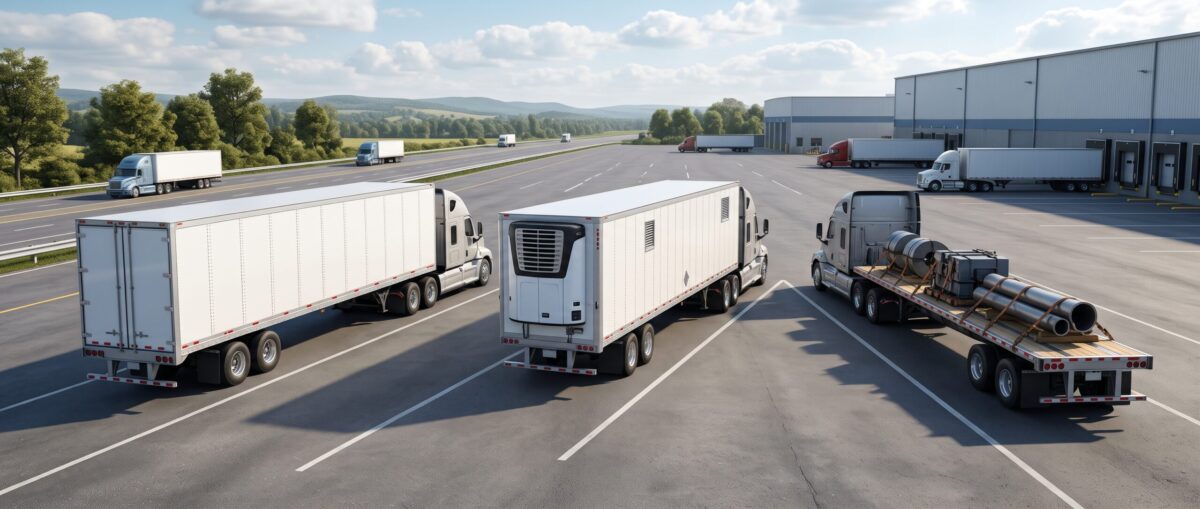
Which Trailer Type Does Your Full Truckload Shipment Need?
Trailer choice is the first decision in every truckload quote, and it moves price more than most shippers expect. Too little trailer and the load cannot move legally; more than you need and you pay for capability you never use. Among full truckload trailer types, the FTL equipment options break down into enclosed vans, temperature-controlled vans, and open decks, and each exists because a class of freight cannot travel any other way. First Class Trucking runs all three families nationwide, and this guide walks through the same selection we make with shippers on every lane.
How to Match a Trailer to Your Freight
Work through four questions in order and the trailer picks itself. Protection from weather and theft? You are in a van. Temperature control? That selects the reefer. Any dimension bigger than a van interior, roughly 8 feet wide, 8 and a half feet tall, or 52 feet of floor? Open deck. Side or crane loading? Also open deck.
Most shippers only need the first question, which is why the dry van dominates. It is the default equipment on our full truckload shipping services lanes, and every other trailer type is a specialist answer to a freight problem the van cannot solve.
Dry Van: the Default Full Truckload Trailer
A 53-foot dry van is an enclosed box trailer with roughly 636 inches of floor length, an interior about 98 to 100 inches wide, and 108 to 110 inches of usable height. It holds 26 standard 48×40 pallets straight-loaded, up to 30 turned, and around 45,000 pounds of cargo. The freight travels sealed, dry, and out of sight.
Choose a dry van when your freight is palletized, boxed, or crated and fits the interior cube. Choose something else when temperature matters, when the freight is taller than the door, longer than the floor, or must load from the side or by crane. It is also the cheapest and most available equipment on most lanes.
Refrigerated Trailers: When Temperature Is the Spec
A refrigerated trailer, or reefer, is a dry van with insulated walls, a refrigeration unit, and temperature recording. Frozen freight rides at set points down to about minus 20 degrees Fahrenheit, chilled goods at 34 to 40, and dual-zone trailers split both in one load. Insulation and machinery eat interior space, so a 53-foot reefer carries around 24 pallet positions instead of 26, with payload about a thousand pounds lighter.
Pick a reefer when the product spoils, melts, or is regulated at a temperature. Produce, dairy, meat, pharmaceuticals, and certain chemicals all ride refrigerated. If your freight fits that profile, our refrigerated trucking services run single-temp, dual-temp, and multi-zone equipment with continuous monitoring, and the reefer premium over dry van is the price of arriving as product instead of claim.
Flatbeds, Step Decks, and RGNs: the Open-Deck Family
Open decks carry what cannot fit inside a box. A standard flatbed is a 48 or 53-foot deck, 102 inches wide, riding about 5 feet off the ground, with no walls or roof. Freight can overhang within legal limits, load from the side or by crane, and ride taller than any van interior. Payload typically runs to about 48,000 pounds, and tarps replace the roof when weather protection is still needed.
Tall freight steps down. A step deck drops its main deck to roughly 42 inches, which buys about two extra feet of legal freight height, and hauls around 44,000 pounds. Machinery goes lower still: a removable gooseneck, or RGN, detaches its front so equipment drives onto the deck, and heavy configurations carry roughly 38,000 pounds and up with permits. Legal freight height caps at 13 feet 6 inches in most states east of the Mississippi and 14 feet in many western states.
Open-deck freight also lives by securement: chains, straps, and tarps applied to DOT tie-down standards, which is core training for our flatbed trucking services drivers on standard flatbeds, step decks, double drops, and RGNs.
Dry Van vs Reefer vs Flatbed at a Glance
The table compares the families on the specs shippers decide with; payload figures are typical cargo limits and shift with tractor weight and state rules.
| Trailer type | Length | Enclosed | Typical payload | Best for |
|---|---|---|---|---|
| Dry van | 53 ft | yes, sealed | about 45,000 lb | pallets, boxes, crated goods |
| Refrigerated van | 53 ft | yes, temp-controlled | about 44,000 lb | produce, dairy, pharma, chemicals |
| Flatbed | 48 to 53 ft | no, tarps optional | about 48,000 lb | lumber, steel, machinery, building materials |
| Step deck | 48 to 53 ft | no, tarps optional | about 44,000 lb | tall equipment, tanks, prefabricated parts |
| RGN | varies | no | about 38,000 lb plus permits | drive-on machinery, heavy equipment |
Two boundaries decide most edge cases. Interior height of a van is about 110 inches, so freight near 9 feet tall needs a step deck. Legal width is 102 inches including load, so anything wider rides permitted regardless of trailer.
Weight Limits: Why Payload Varies by Trailer
Every combination here shares one legal ceiling: 80,000 pounds gross, tractor, trailer, fuel, and cargo together, on the Interstate System under 23 U.S.C. 127 (Cornell LII), with 20,000 pounds on a single axle and 34,000 on a tandem. The trailer’s own weight comes off that budget, which is why a light flatbed hauls more than a heavier reefer. Heavier freight than the payload column allows still moves, but it needs permits and an axle plan.
How Trailer Choice Changes Cost and Loading
Dry van is the price floor on nearly every lane because supply is deepest, which is why First Class Trucking quotes van equipment unless the freight rules it out. Reefers add a premium for the unit, fuel, and monitoring, and capacity tightens in produce season. Open decks price on securement, tarps, and permits, so a wide steel load can still undercut a van move that cannot legally happen.
Loading style follows the same logic. Van freight works best with dock appointments or a trailer loop, and the fastest dock experience in trucking is the drop and hook setup, where your team pre-loads a trailer and the driver swaps it in minutes. Open-deck freight plans backward from securement instead, with the driver chaining and tarping before the wheels turn.
Frequently Asked Questions
What is the most common trailer in full truckload shipping?
The 53-foot dry van. It carries 26 standard pallets at about 45,000 pounds, encloses the freight, and is usually the cheapest and most available equipment.
Is a reefer more expensive than a dry van?
Yes, typically. The refrigeration unit, insulation, monitoring, and fuel add a premium, and reefer capacity tightens in produce season. You are paying for the freight to arrive at temperature.
Can a flatbed carry palletized freight?
Yes. Pallets load by forklift from the side and ride strapped or tarped. It usually costs more than a van for the same pallets, so flatbed pallets make sense when freight is oversized, side-loaded, or crane-loaded.
What is the difference between a step deck and an RGN?
A step deck lowers the deck for taller freight but loads the same way as a flatbed. An RGN detaches its gooseneck so machinery drives onto the deck, which is why heavy equipment moves on RGNs.
How tall can freight be on a step deck?
The lower deck rides about 42 inches off the road, so freight around 10 feet tall stays under the 13-foot-6-inch legal height common east of the Mississippi, where a van’s 110-inch interior would force a permit.
How many pallets fit in a 53-foot dry van?
26 standard 48×40 pallets straight-loaded, up to 30 turned, and up to 52 double-stacked when cargo height and weight allow. A reefer typically holds around 24 positions.
Which trailer do I need for a 45,000-pound load?
A 53-foot dry van handles 45,000 pounds of palletized freight. If the load is also tall, wide, or side-loading, a flatbed or step deck with an axle plan is the better fit.
Pick Your Trailer With Us
Send us the freight dimensions, weight, temperature needs, and how it loads, and we will match the equipment and quote the lane the same day. At First Class Trucking, we would rather spec the right trailer once than explain the wrong one at the dock.
Request a free quote online, or call (954) 228-2441 and we will size the equipment with you.