
An Anti‑Lock Braking System (ABS) is an automated brake-control technology that detects when a wheel is about to lock and instantly adjusts brake pressure to keep traction and steering control during heavy stops. This article breaks down what ABS does on commercial trucks, how the main parts — wheel speed sensors, the electronic control unit (ECU), and hydraulic modulators — work together, and why fleets rely on ABS to protect drivers and cargo. With changing road surfaces, heavy loads, and tight delivery windows, fleets need predictable braking. ABS reduces skids, helps prevent jackknifing, and delivers steadier stopping behavior under load. You’ll find clear explanations of how ABS operates, the key components and their interactions, measurable safety benefits, regulatory considerations, practical maintenance checklists, and how First Class Trucking Corp. applies ABS-aware practices in field services and fleet reliability. Below we walk through the system step‑by‑step, compare benefits with a concise EAV-style table, and offer inspection and compliance guidance so fleet teams can assess ABS value and readiness.
What is an Anti‑Lock Braking System in Commercial Trucks?
An Anti‑Lock Braking System on a commercial truck is a brake-control system that prevents wheel lock‑up by reading wheel speeds and automatically adjusting hydraulic or electronic brake pressure to preserve traction and steering. During braking events the system monitors individual wheel deceleration, sends that data to an ECU, and commands modulators to reduce and reapply pressure as needed to avoid a locked wheel. For heavy vehicles, this means drivers can retain steering control during hard stops, lower the risk of skids or jackknives, and achieve more consistent stopping under varying loads. With that foundation, the next section explains how sensors and modulators interact in real time to produce those safety outcomes.
How does ABS prevent wheel lock‑up and skidding?
ABS prevents wheel lock‑up by continuously monitoring wheel speed sensors. If a sensor detects sudden deceleration at a wheel, it signals the ECU, which pulses the hydraulic modulators several times per second to relieve and then reapply brake pressure. Those rapid pressure pulses let a slipping wheel regain traction before firm braking resumes, preventing a locked, sliding state. The system preserves longitudinal braking force while maintaining the lateral grip needed for steering — especially useful on wet or icy roads. Watching the sensor → ECU → modulator feedback loop makes clear why ABS is effective during emergency stops and sharp maneuvers.
Why is ABS essential for heavy‑duty vehicles and commercial trucking?
ABS is critical for heavy trucks because mass, shifting cargo, and long stopping distances make wheel lock‑up and loss of control far more hazardous. Heavy loads change weight distribution, increasing the chance of wheel slip on variable surfaces and raising jackknife and rollover risk if braking forces aren’t actively managed. For fleets, ABS protects cargo and reduces liability by improving stopping predictability and lowering crash risk during sudden decelerations. That’s why ABS is a core element of fleet safety strategies and works best alongside systems like ESC and telematics for broader risk management.
How Does ABS Work in Heavy Duty Vehicles?
On heavy vehicles ABS works as a closed‑loop control system: wheel speed sensors stream rotational data to the ECU, the ECU evaluates relative wheel deceleration and issues commands to modulators, and those modulators pulse hydraulic pressure to prevent lock‑up while preserving braking force. This cyclical control balances braking across axles and wheels, with each modulation informing the next. The breakdown below clarifies the primary components and their roles so fleet technicians and safety officers can picture system behavior during an emergency stop.
What are the key components of a commercial truck ABS system?
The main parts of a commercial truck ABS are wheel speed sensors at each wheel or axle, an electronic control unit (ECU) that processes sensor data and runs diagnostics, hydraulic modulators or valves that alter brake line pressure, and the wiring and dashboard indicators that alert the driver. Wheel speed sensors generate signals proportional to wheel rotation and can be compromised by corrosion or wiring damage. The ECU reads those signals to detect slip events and instructs modulators to act. Hydraulic modulators quickly reduce and reapply pressure to the brake actuators, producing the pulsing behavior drivers associate with ABS. Knowing these parts helps technicians prioritize troubleshooting when an ABS warning appears.
| Component | Role | Signal / Pressure Change |
| Wheel Speed Sensor | Measures rotational speed of each wheel | Voltage or frequency signal tied to wheel RPM |
| Electronic Control Unit (ECU) | Processes inputs and runs control logic | Sends timed on/off commands to modulators |
| Hydraulic Modulator/Valve | Rapidly adjusts brake line pressure | Relieves and then reapplies hydraulic pressure in pulses |
This component map clarifies responsibilities inside the ABS control loop and helps mechanics decide where to focus when diagnosing warnings, which leads into how those parts cooperate in practice.
How do these components interact to maintain steering control during braking?
When the driver brakes, wheel speed sensors feed live data to the ECU, which compares wheel signals and checks slip thresholds. If a wheel slows unusually fast, the ECU tells the modulator to reduce pressure, then reapply it once traction returns. That rapid sensor → ECU → modulator loop is tuned for heavy‑duty dynamics so each wheel’s traction is preserved and lateral control remains available. On wet or icy roads, repeated modulation prevents extended sliding and lets the driver steer around hazards while braking, reducing jackknife and rollover chances. A typical wet‑road emergency stop is a good example of how synchronized component action sustains control and limits stopping variability.
What Are the Benefits of ABS in Trucking Safety?
ABS delivers clear, measurable safety gains for fleets: it preserves steering, cuts the chance of skids and jackknifes, and produces more predictable stopping across different surfaces. Those operational advantages mean fewer crashes, less cargo damage, and improved schedule reliability when drivers have to brake hard. The list below summarizes the main benefits, followed by a concise comparison that ties mechanisms to fleet value.
ABS provides the following core safety and operational benefits:
- Maintains Steering Control: Keeps steering responsive during heavy braking so drivers can avoid obstacles.
- Reduces Skidding and Jackknifing: Modulation prevents wheel lock‑up that can cause trailer instability.
- Improves Stopping Predictability: More consistent deceleration reduces variability in stopping distances.
- Protects Cargo and Lowers Liability: Fewer incidents mean less cargo damage and lower claims exposure.
These advantages explain why ABS is standard practice for many fleets and why teams should measure its impact through diagnostics, training, and service records.
| Benefit | Mechanism | Fleet-level Value |
| Steering control | Pulsed pressure prevents wheel lock‑up | Fewer evasive collisions; better obstacle avoidance |
| Reduced jackknifing | Balanced braking across axles | Lower trailer loss incidents and cargo claims |
| Stopping consistency | ECU‑managed modulation under varying loads | Predictable braking; improved schedule reliability |
Connecting technical mechanisms to operational outcomes helps fleet managers see where ABS delivers the most value. Next we cover the regulatory landscape and how it affects ABS deployment and compliance.
What Are the ABS Regulations for Semi Trucks and Commercial Vehicles?
Yes — federal and industry rules require ABS on many classes of commercial vehicles. Applicability depends on vehicle type, gross vehicle weight rating (GVWR), and model year. National safety standards phased in ABS fitment for certain tractors and trailers to improve road safety; inspectors and enforcement programs confirm system operation and expect documented maintenance. Knowing which vehicles and model years fall under these mandates helps fleets design targeted compliance workflows and inspection readiness plans, summarized below.
The following list highlights regulatory focal points fleet managers should track:
- FMVSS‑related mandates and applicability by vehicle class and year.
- Inspection priorities from safety alliances and enforcement agencies.
- Cross‑border requirements for operations between the USA, Canada, and Mexico.
Below is a compact regulatory table that connects rules to concrete fleet actions.
| Regulation | Applies To | Compliance Action |
| FMVSS ABS mandates | Specified commercial vehicles and trailers by class/year | Confirm OEM fitment and keep operational records |
| CVSA inspection criteria | Vehicles subject to roadside inspections | Ensure ABS warning lamps and signals pass functional checks |
| Cross‑border rules | Trucks on USA/Canada/Mexico routes | Align maintenance and documentation to each jurisdiction |
Mapping regulations to action items helps fleets prioritize retrofits, scheduled checks, and recordkeeping, which leads into recommended inspection and maintenance practices that keep ABS performing well.
Which federal and industry regulations mandate ABS installation?
Federal Motor Vehicle Safety Standards (FMVSS) rolled out ABS requirements across multiple rulemaking cycles, specifying installation and performance requirements for certain vehicle classes and model years. Industry inspection programs — including those run by vehicle safety alliances — focus on functional ABS checks during roadside inspections. Cross‑border operators must reconcile additional jurisdictional requirements. Fleet managers should verify rule applicability by class and production year, and keep records that show functional operation to satisfy audits and inspections. Those regulatory triggers inform the maintenance approach described next.
How does compliance with ABS regulations impact fleet safety and inspections?
ABS compliance affects inspection results, insurance exposure, and route permissibility. Nonfunctional or missing ABS components can lead to out‑of‑service findings and increased liability. Maintaining documentation, running routine functional checks, and fixing faults promptly reduce inspection failures and demonstrate proactive safety management to regulators and insurers. Setting internal policies that tie maintenance schedules to regulatory milestones improves inspection readiness and helps preserve uptime. Next we cover the practical steps for diagnosing and maintaining ABS across a fleet.
How is ABS Maintained and Diagnosed in Commercial Truck Fleets?
Reliable ABS performance comes from scheduled inspections, sensor and wiring care, ECU diagnostics, and quick fault remediation. A preventive program should include visual checks for sensor damage or corrosion, scan‑tool reads for ECU fault codes, hydraulic integrity inspections for modulators, and documented repair logs. Good maintenance minimizes false warnings and prevents degraded ABS response when it matters most. The next section lists common warning signs to triage before deeper diagnostics.
What are common ABS issues and warning signs in trucks?
Typical ABS problems include illuminated ABS warning lamps, a changed brake feel, uneven stopping, and diagnostic trouble codes that point to sensor faults or hydraulic leaks. Environmental exposure — water intrusion, corrosion, and damaged connectors — often causes sensor or wiring failures. When the ABS light comes on, the ECU may have disabled the ABS and reverted to conventional braking. Fast triage steps: capture the fault code with a scan tool, inspect reluctor rings and connectors for contamination, and check wheel speed signal continuity. Early recognition lets technicians target repairs and restore system readiness quickly.
What maintenance practices ensure optimal ABS performance?
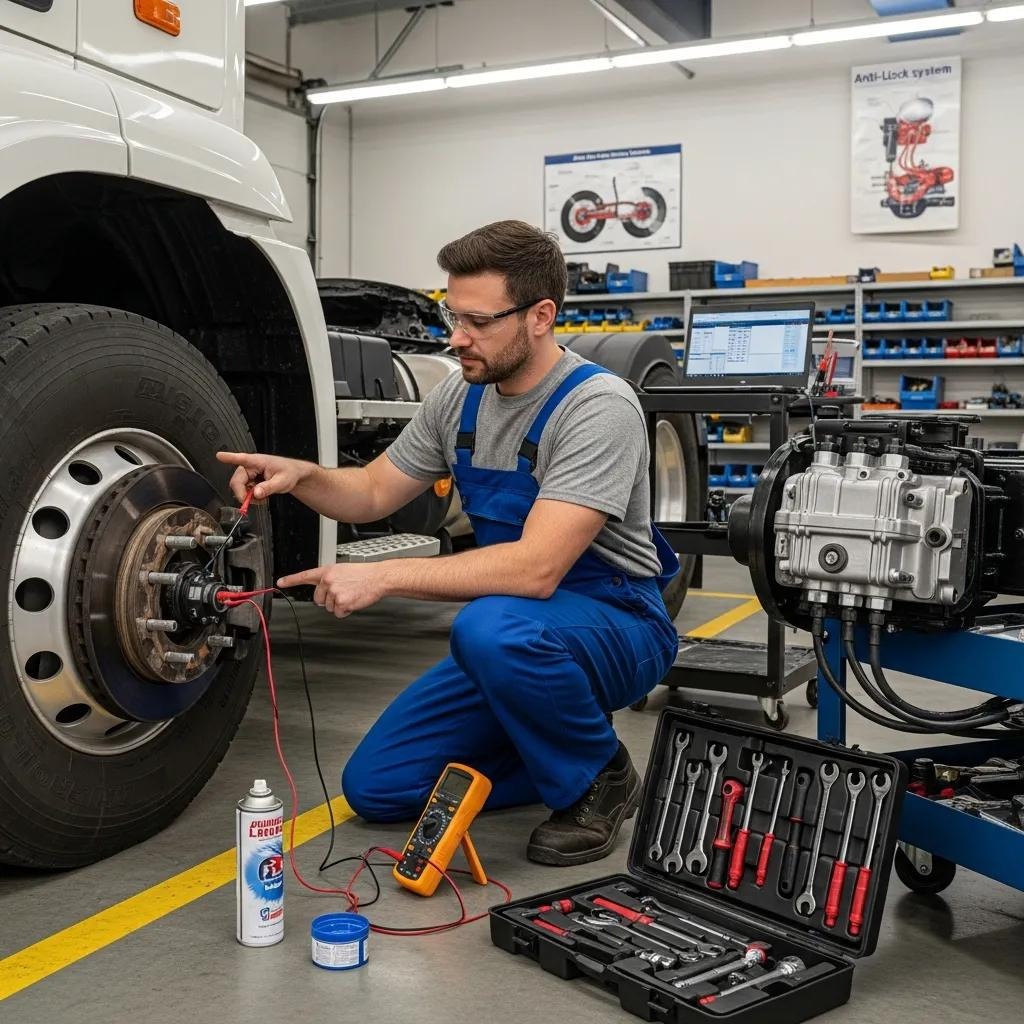
To keep ABS operating reliably, fleets should schedule sensor cleanings and inspections, run ECU diagnostic scans during preventive service, check hydraulic system integrity, and replace worn parts per manufacturer guidance. Keeping wheel speed sensors clean and wiring intact prevents false signals; logging maintenance in your fleet system supports trend analysis and predictive replacement. If you prefer outsourced support, First Class Trucking Corp. follows consistent standards for readiness and can coordinate inspection and maintenance work through its operations team to help preserve uptime and compliance.
Routine ABS maintenance checklist:
- Inspect sensors and wiring for corrosion or damage at every preventive service interval.
- Run ECU scan diagnostics to capture and clear fault codes during scheduled maintenance.
- Verify hydraulic modulator integrity and check brake‑fluid condition to prevent pressure anomalies.
These baseline checks reduce inspection failures and unplanned downtime when fleets need their trucks on the road.
How Does First Class Trucking Incorporate ABS for Safer Field Services?
First Class Trucking Corp. prioritizes safety and reliability across Less‑Than‑Truckload, Full Truckload, flatbed, and specialized transport by aligning operations with proven safety technologies like ABS and complementary systems. As a logistics resource and lead generator, we emphasize safety‑coordinated routing, real‑time cargo tracking, and inspection readiness. While detailed ABS configurations aren’t listed on service pages, our operational practices include ABS‑aware maintenance and monitoring to support on‑time, secure deliveries. Customers can request tailored quotes that reflect specific safety and compliance requirements. For open‑air or oversized cargo, our oversized loads options provide secure handling for nonstandard loads.
How does ABS integration support First Class Trucking’s reliable freight transportation?
ABS‑equipped trucks help First Class Trucking keep schedules when weather or sudden stops threaten delays. By reducing skids and preventable incidents, functional ABS supports fewer route interruptions and less cargo damage. That reliability pairs with real‑time tracking so operations can respond quickly to exceptions. Clients hauling oversized, refrigerated, or hazmat loads benefit from this risk‑managed approach; businesses that need ABS‑equipped transport can contact First Class Trucking to request a quote or discuss specific safety needs for a shipment.
What advanced safety technologies complement ABS in the company’s fleet?
Systems that work well with ABS include Electronic Stability Control (ESC) for yaw and rollover mitigation, Tire Pressure Monitoring Systems (TPMS) to help maintain traction, and telematics for live diagnostics and driver coaching. Together they form a layered safety strategy: telematics flags ABS faults and braking anomalies for maintenance dispatch, while ESC and TPMS reduce the conditions that stress ABS in the first place. When evaluating carriers, ask about integrated safety systems, inspection protocols, and tracking capabilities to ensure alignment with your cargo protection and risk tolerance needs.
Technologies that commonly complement ABS include:
- Electronic Stability Control to reduce lateral instability during abrupt maneuvers.
- Tire Pressure Monitoring Systems to keep traction optimized and reduce uneven wear.
- Telematics and live tracking to monitor braking events and support proactive maintenance.
| Regulation | Who/When It Applies | Fleet Checklist Item |
| FMVSS ABS‑related standards | Specified commercial vehicle classes by manufacture date | Confirm OEM ABS fitment and maintain functional test records |
| CVSA inspection focus | All commercial vehicles during roadside inspections | Ensure ABS warning lamps are off and sensors are operational |
| Cross‑border compliance guidance | Trucks moving between the USA, Canada and Mexico | Align documentation and maintenance with route‑specific rules |
This table helps fleets plan compliance tasks and talk with service providers about inspection readiness.
If you need inspection or ABS‑ready transport services, consider these steps:
- Request vehicle safety system specifications and inspection practices.
- Ask for a maintenance and inspection schedule that includes ABS diagnostics.
- Confirm real‑time tracking and coordination capabilities for sensitive shipments.
| Component | Attribute | Frequency |
| Wheel Speed Sensors | Cleanliness and connector integrity | At every preventive service interval |
| ECU | Diagnostic scan and firmware checks | Quarterly or per service schedule |
| Modulators/Hydraulics | Pressure integrity and leak inspection | During brake‑service intervals |
This maintenance table connects components to practical inspection intervals so fleets can plan and maintain ABS readiness.
Those maintenance and service alignment steps close the gap between ABS capability and real‑world reliability, giving fleets clear next steps to evaluate ABS value and request tailored transport solutions.
Frequently Asked Questions
What are the differences between ABS and traditional braking systems?
ABS (Anti‑Lock Braking System) adds an active control layer to conventional braking. Traditional systems can lock wheels under hard braking, causing skids and loss of steering. ABS modulates brake pressure to prevent lock‑up and preserve directional control, which is especially valuable for heavy vehicles under load. In short: traditional brakes stop the vehicle; ABS helps you stop while staying in control.
How can fleet managers ensure their trucks are compliant with ABS regulations?
Fleet managers should regularly review federal and state rules for their vehicle classes, verify ABS installation on applicable trucks, keep operational records, and run routine inspections to confirm system function. Staying current with regulatory changes, conducting internal audits, and training maintenance staff will help demonstrate compliance during inspections. Clear documentation of maintenance and functional checks is essential.
What impact does ABS have on insurance premiums for trucking companies?
ABS can positively influence insurance costs because it reduces accident risk and potential claims. Insurers often view ABS‑equipped fleets as lower risk, which can translate to better premiums. To capture potential discounts, share maintenance records and safety program details with your carrier to demonstrate your proactive risk management.
What are the common misconceptions about ABS in trucking?
One misconception is that ABS always shortens stopping distances. While it improves control, ABS doesn’t guarantee shorter stops in every condition; its main benefit is maintaining steering control. Another is that ABS replaces safe driving — it doesn’t. Drivers still must manage speed, following distance, and technique. Training helps set realistic expectations and ensures drivers use ABS correctly.
How does weather affect the performance of ABS in trucks?
Weather affects ABS performance: the system is particularly helpful on wet or icy roads because it prevents wheel lock‑up and maintains steering. In extreme conditions — deep snow or black ice — stopping distances can still be long and ABS effectiveness may be limited. Drivers should adapt braking techniques to conditions even when ABS is active; training on those adjustments improves safety.
What role does driver training play in the effectiveness of ABS?
Driver training is essential. Knowing how ABS works and its limits helps drivers respond correctly in emergencies — for example, trusting the system and holding firm pressure rather than pumping the brakes. Scenario‑based training and regular refreshers reinforce safe braking habits and make ABS an effective part of fleet safety performance.
Conclusion
Anti‑Lock Braking Systems significantly improve safety for commercial trucks by maintaining steering control and reducing the risk of skids and jackknifing. Understanding ABS mechanics, benefits, and compliance obligations lets fleet managers prioritize maintenance and operational practices that protect cargo and limit liability. If you want to strengthen your fleet’s braking readiness, explore our maintenance and inspection services. Contact First Class Trucking Corp. to make sure your fleet is safe, compliant, and ready for reliable operations.