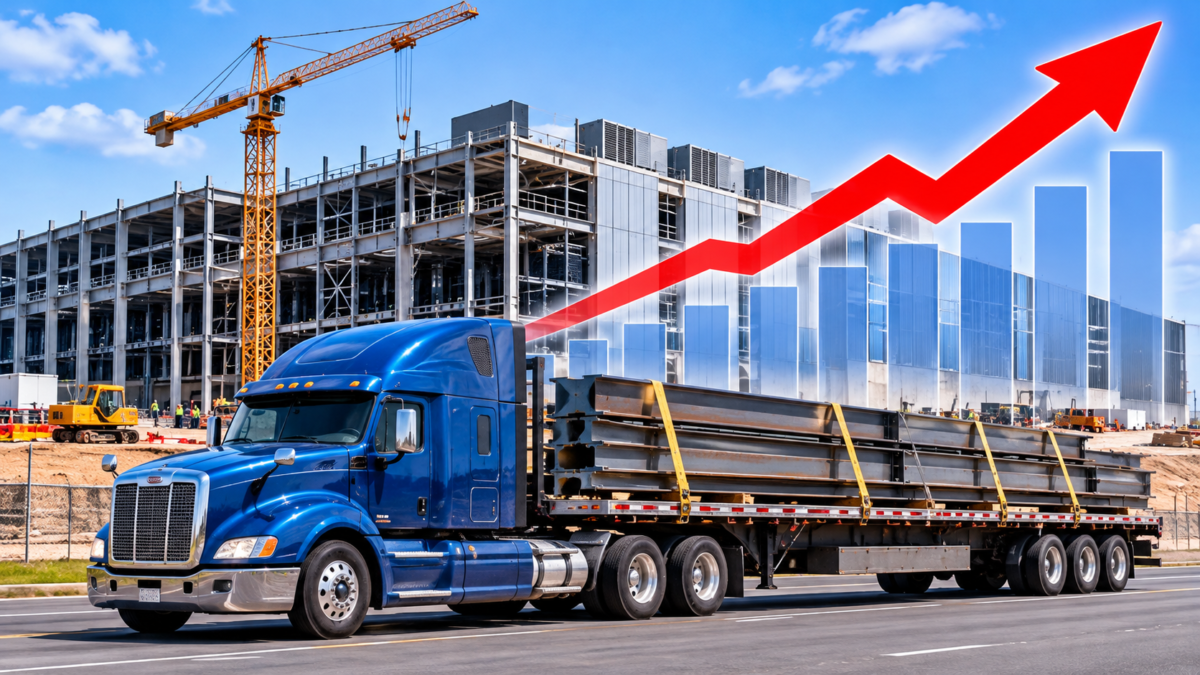
Will Flatbed Rates Keep Rising as Data Center Construction Grows?
Short answer: Most likely yes, but slower and less evenly than in 2026. Flatbed spot rates are still running roughly 30% above last year, and forecasters expect another increase of around 10% in 2027. The pace will depend on how many announced data center projects actually break ground, because only a fraction of the pipeline is under construction today.
If you ship steel, precast concrete, electrical gear or heavy equipment, 2026 has been an expensive year to book open-deck capacity. The reason is not a broad freight boom. Dry van demand has been uneven and housing remains soft. The pressure comes from one place: the build-out of AI data centers and the power infrastructure that feeds them. Here is what the numbers show and what they suggest for the next 12 months.
Where flatbed rates stand heading into 2027
According to DAT Freight & Analytics, the national flatbed spot linehaul rate averaged $2.60 per mile (excluding fuel) for the week reported on November 16, 2026. That is up $0.62 per mile, or 31.4%, from a year earlier and about 27% above the nine-year seasonal average of $2.05.
The summer peak was higher still. In July, DAT reported spot rates near $2.95 per mile, 44% above the prior year and above the previous 2021 record on a fuel-excluded basis. The autumn pullback is normal construction seasonality, not a collapse.
Contract pricing is now following spot upward. ACT Research reported that September flatbed contract rates were up 18% year over year, while spot was up 29%. Early in the year, contract rates were still down from 2025, so that shift matters: shippers renewing annual agreements are now seeing the increase land in their contracted lanes, not just on the spot board.
Two other signals point to a tight market:
- Load-to-truck ratio: Flatbed posted 33 loads for every available truck in mid-November, compared with about 18 a year ago. Flatbed remains the tightest of the three major equipment types.
- Regional premiums: The highest-paying origins are the Ohio River ($3.13 per mile), Lower Atlantic ($2.93) and Great Lakes and Southeast ($2.87 each). Those regions overlap heavily with active data center, manufacturing and power generation projects.
Why data center construction absorbs so much flatbed capacity
Data center construction starts in the U.S. reached about $84 billion through July 2026, nearly three times the same period in 2025 and close to a quarter of all nonresidential building starts, according to ConstructConnect data. North Carolina and Texas lead the country in year-to-date starts.
The freight impact is large because these projects are material-heavy. DAT estimates that each gigawatt of new data center capacity requires roughly 100,000 truckloads of concrete, structural steel, transformers, switchgear and generators. About 20 GW has been built since 2023 (around 2 million truckloads), and roughly 50 GW is announced for 2026 and 2027, which would mean about 5 million more truckloads in two years. Industry estimates put 50% to 70% of that freight on flatbed or other open-deck equipment.
What actually ships on open deck to a data center site
Freight demand shifts as a campus moves through its 18 to 24 month build:
- Shell and structure: structural steel beams, joists, metal decking, rebar and precast concrete wall panels. These move mostly on standard flatbeds and step decks.
- Power and cooling: transformers, switchgear, backup generators, chillers and cooling units. Large power transformers can weigh well over 50 tons and often need double drop or RGN trailers, oversize permits and route surveys.
- Site utilities: pipe, culverts, cable reels and conduit, typically on flatbeds.
Because power equipment has long manufacturing lead times, these loads tend to arrive in bursts tied to factory release dates, which creates sudden demand spikes on specific lanes.
The “capacity tax” on everyone else
In a FreightWaves interview, IntelliTrans executive Blake Azell described the effect as a capacity tax. Hyperscale developers are largely insensitive to freight cost because a late transformer can delay a billion-dollar facility. They pay what it takes to secure trucks, and that pulls flatbed and specialized capacity away from shippers of building materials, metals, chemicals and machinery. Those shippers end up paying elevated rates even though their own freight volumes have not grown.
Capacity is also shrinking on the supply side. Small fleets and owner-operators make up much of the flatbed market, and many have exited since the 2023 to 2025 freight downturn. Tighter driver qualification enforcement has removed further capacity in 2026.
What could push flatbed rates higher
- A large unbuilt pipeline. FreightWaves research found that only about 8% of announced and contracted data center projects were under any level of construction. DAT puts the share of the 2026 pipeline under active construction at roughly one third. If even part of the remainder breaks ground in 2027, demand rises from today’s level.
- Power generation follows data centers. Natural gas generators, diesel backup units and grid upgrades are being ordered in large volumes. DAT’s Dean Croke has noted that the spot market has been strong for 18 months on demand tied to data centers, nuclear power and gas and diesel generation.
- Contract resets. Contract rates trail spot. With spot still above last year and contract rates only now catching up, many 2027 renewals will price higher.
- Thin spare capacity. With fewer carriers in the market, weather events, hurricane recovery work or a spring construction surge can move rates faster than in past cycles.
What could cool flatbed rates
- Project delays and cancellations. DAT estimates that close to half of announced projects could slip or be canceled because of power availability, local permitting or financing. Trucking Dive has also reported analyst warnings that some announced spending may be overstated.
- Soft core flatbed sectors. Housing, cross-border freight and parts of manufacturing remain weak. If data center work pauses, there is no other sector large enough to replace it right away.
- Seasonality. Winter usually lowers construction activity and flatbed spot rates. Expect a dip between December and February before spring demand returns.
- Returning capacity. Higher rates attract carriers back. DAT has noted truck posts rising in recent weeks, which loosens the board at the margin.
So, will flatbed rates keep rising?
The weight of the evidence says yes, with moderation. C.H. Robinson forecasts that flatbed rates will finish 2026 about 28% higher than 2025 and rise roughly another 10% in 2027, citing manufacturing and data center construction. DAT’s short-term forecast calls for spot linehaul to hold in a narrow range near $2.57 to $2.70 per mile through late December.
The realistic outlook for 2027 looks like this:
- Increases continue, but at a slower rate than the 30% to 40% year-over-year jumps of 2026, because 2027 is compared against a much higher base.
- Volatility stays high. Data center freight is lumpy and lane-specific, so national averages will understate the spikes on routes serving active campuses.
- Specialized equipment stays the tightest. Step deck, double drop and RGN capacity for transformers and generators will remain harder to book than standard flatbeds.
What shippers should do now
- Book earlier. On lanes feeding data center regions, give carriers more lead time than you did in 2025, especially for oversize loads that need permits.
- Match the trailer to the load. A step deck or double drop can avoid an oversize permit on taller freight. Choosing the right equipment up front prevents re-quotes and delays.
- Review your contract and spot mix. If your contract rates were set early in 2026, check that carriers can still honor them. A tiered backup carrier list reduces exposure to rejected tenders.
- Benchmark by lane, not by national average. Ohio River and Southeast lanes price very differently from South Central or Mountain lanes.
- Plan around the build calendar. If you supply a data center project, align shipments with the contractor’s delivery windows to avoid detention and missed slots.
Moving data center and construction freight with Truck First Class
Truck First Class provides flatbed trucking services for heavy, oversized and irregular freight across the country, with flatbed, step deck, double drop and RGN equipment. Loads are secured to DOT tie-down standards, routed to meet state oversize requirements and tracked in real time from pickup to delivery. Whether you are moving structural steel to a jobsite or a transformer to a substation, our team can match the right trailer to your load and quote it quickly. Request a flatbed quote today to lock in capacity before the next construction season.
Frequently asked questions
Why are flatbed rates so high in 2026?
Data center construction and related power projects are absorbing flatbed and specialized capacity at the same time that the number of carriers has declined. The result is spot rates roughly 30% above 2025.
How much freight does a data center generate?
DAT estimates about 100,000 truckloads per gigawatt of capacity. A single 500 MW campus can require around 30,000 truckloads of steel, concrete, electrical equipment and generators.
Will flatbed rates go down in 2027?
Most forecasts expect moderate increases rather than declines, around 10% according to C.H. Robinson. Rates could soften on some lanes if a large share of announced projects is delayed or canceled.
What trailer do data center transformers ship on?
Large power transformers usually ship on double drop, RGN or multi-axle heavy-haul trailers because of their height and weight. Smaller electrical gear and switchgear often moves on step decks.