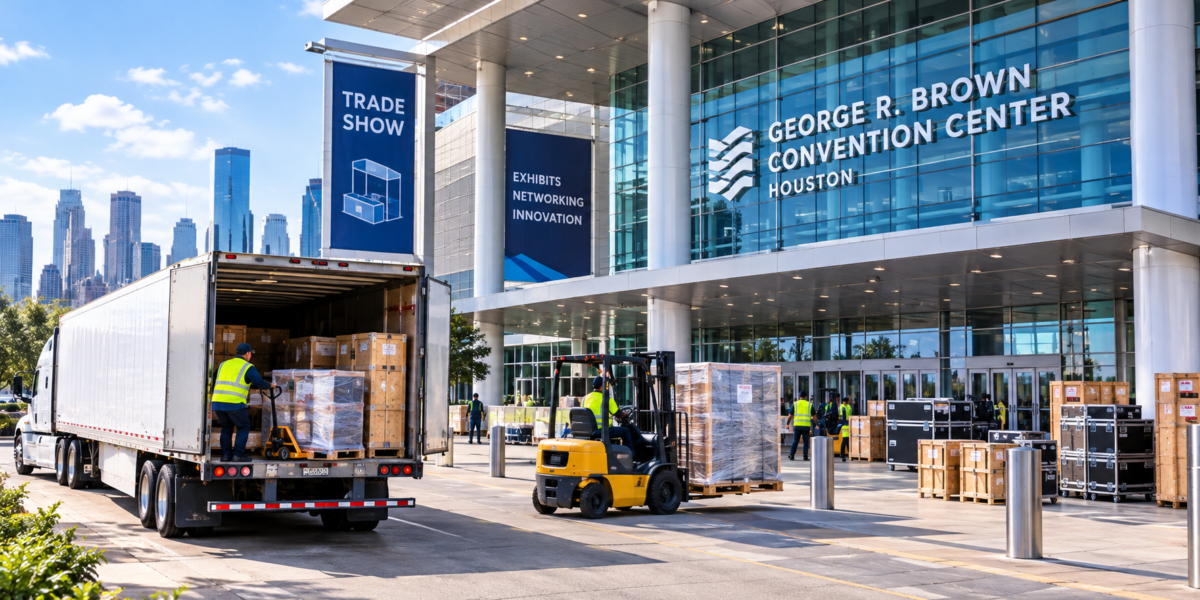
Who Can Deliver Trade Show Freight to Houston’s George R. Brown Convention Center on Time?
The carrier that delivers trade show freight to the George R. Brown Convention Center on time is the one that plans backward from your show’s target window, not forward from the pickup date. That means dispatch timed to the move-in schedule, a driver who knows the check-in process, and paperwork that matches the exhibitor kit line for line.
First Class Trucking moves freight into Houston with 24/7 dispatch, real-time shipment tracking, and a network of more than 12,000 TSA-approved drivers. Below is how GRB deliveries actually work, where exhibitors lose time, and how to pick the right truck for your booth.
Why George R. Brown Convention Center deliveries are different
The George R. Brown Convention Center (GRB) is a downtown venue with tight dock scheduling, so every truck arrives on an assigned window instead of whenever it gets there. The building sits at 1001 Avenida de las Americas, between I-45 and I-69/US-59, with seven exhibit halls and 66 loading docks on two levels.
That dock count sounds generous until a large show moves in. Hundreds of exhibitors, decorators, and AV crews all compete for the same doors over two or three days. Show management and the general service contractor, usually GES or Freeman, assign each booth a target date and time to keep the floor moving.
The venue is operated by Houston First Corporation, the city’s local government corporation for convention facilities. Houston First runs the building, but the freight rules for your event come from the show’s exhibitor services manual. Read that manual first; it overrides anything general you read online, including this article.
What is a convention marshalling yard?
A convention marshalling yard is an off-site staging lot where trucks check in, get weighed, and wait until a dock opens at the venue. Large shows use one to keep idling trucks off downtown streets and to release freight to the floor in a set order.
When a show runs a marshalling yard, the typical process looks like this:
- The driver checks in at the yard with the exhibitor name, booth number, and show name.
- The truck is weighed loaded to record the gross weight.
- The driver gets a queue number and waits to be dispatched to a GRB dock.
- After unloading, the truck returns to the yard for its empty (tare) weight and the signed receiving report.
Wait times depend on how many trucks arrive at once and how many booths share a load. A truck that skips the yard and drives straight to the building is usually sent back and placed at the end of the line. Not every GRB show uses a marshalling yard, so check your exhibitor kit for the yard address and hours.
Advance warehouse or direct to show site?
Ship to the advance warehouse when your freight is crated and you want it on the floor first. Ship direct to show site when your freight is loose, oversized, or needs a specific arrival time.
| Option | How it works | Best for | Watch out for |
|---|---|---|---|
| Advance warehouse | Freight arrives at the contractor’s Houston warehouse days or weeks early and is moved to your booth before direct deliveries start | Crated, carton, or fiber-case freight; exhibitors flying in late | Arrival deadline (often a week before move-in); some warehouses refuse uncrated freight |
| Direct to show site | Your carrier delivers to GRB on your assigned target day and time | Machinery, display builds, loose or floor-loaded freight | Overtime rates outside straight-time hours; missed windows |
Many GRB show kits list direct deliveries between roughly 8:00 AM and 4:00 PM on move-in days, with overtime charges outside straight time. Your kit will list the exact hours for your hall.
What happens if your truck misses its target window?
A truck that misses its target window waits for a work-in slot at the discretion of show staff, which can mean hours of delay or a next-day unload. The costs stack up fast:
- Your setup crew sits idle, often on overtime.
- Late freight can carry off-target or late handling surcharges from the contractor.
- The carrier may bill detention for the time the driver waits.
Detention is one of several accessorial charges like detention and inside delivery that catch Houston shippers off guard. The fix is simple to describe and hard to execute: build buffer into the linehaul, stage the load near Houston the day before, and dispatch to the yard or dock at the start of your window.
LTL or FTL for trade show freight?
The right truck depends on booth size, freight value, and how much control you need over arrival time.
Choose LTL when your exhibit is a few pallets or crates, such as a 10×10 or 10×20 inline booth. Less than truckload (LTL) shipping shares trailer space and cost with other freight, which keeps the price down. The trade-off is less control, since the trailer may make other stops before reaching GRB.
Choose FTL when you have an island booth, heavy machinery, or freight that cannot be handled more than once. A full truckload service gives you a dedicated trailer that runs straight from your dock to the venue. You set the arrival time, and nobody else’s freight sits on top of yours.
For oversized equipment, flatbed or step-deck trailers may be needed. GRB’s hall floors are rated at 1,000 pounds per square foot, but always confirm door sizes and floor load for your specific hall in the exhibitor kit.
What to put on the bill of lading
A trade show bill of lading should carry every detail the receiving dock needs to match freight to a booth on sight:
- Exhibiting company name and booth number
- Show name and dates
- Consignee exactly as the kit lists it (contractor c/o warehouse, or the GRB show site address)
- Piece count, weight, and freight type (crated, padded, skidded)
- Target delivery date and time
- A 24/7 contact phone number for the driver and the shipper
Mismatched consignee wording is a common reason freight sits at a warehouse dock unclaimed.
Plan the outbound move before the show opens
Outbound freight fails more often than inbound. When the show closes, the contractor releases freight to the carrier named on your material handling agreement. If that carrier does not show up on time, your exhibit can become forced freight and be shipped with the house carrier at its rates.
Book the return pickup at the same time as the inbound move, fill out the outbound material handling agreement before move-out, and keep your carrier’s dispatch number in hand on the last day.
How First Class Trucking handles GRB show deliveries
First Class Trucking plans each convention delivery around your target window, then works backward to set pickup, linehaul, and Houston staging. Our Houston trucking services cover inbound exhibit freight, outbound pickup at move-out, and dedicated trucks for high-value displays.
- 24/7 dispatch for early-morning yard check-ins and late move-outs
- Real-time tracking you can share with your booth team, no app required
- LTL, FTL, flatbed, and oversized options for any booth size
- More than 12,000 TSA-approved drivers nationwide
- [CLIENT TO CONFIRM: number of past GRB or Houston convention deliveries, any show names they can cite]
Send us your exhibitor kit, booth number, and freight list, and we will map the timeline to your show. Book your show delivery window – call (954) 228-2441.
Frequently asked questions
How early should I book a carrier for a GRB trade show?
Book three to four weeks before move-in, and earlier for FTL, flatbed, or oversized loads. Advance warehouse deadlines often fall about a week before move-in, so count back from that date if you ship to the warehouse.
Do I have to use the show’s official carrier?
No. Most shows let exhibitors choose their own carrier. Name that carrier on your material handling agreement so the contractor releases freight to them at move-out.
What address do trucks use for George R. Brown Convention Center?
The venue address is 1001 Avenida de las Americas, Houston, TX 77010. If your show runs a marshalling yard or advance warehouse, trucks go there first, so use the address in your exhibitor kit.
Can my carrier pick up freight at move-out?
Yes, if the carrier is named on your outbound material handling agreement and arrives inside the release window. A no-show carrier usually turns your exhibit into forced freight billed at house carrier rates.
Who is liable for freight once it reaches the dock?
Standard carrier liability typically ends at the convention center dock. From there, the general service contractor moves freight to your booth under its own terms, so check your cargo insurance covers the show floor.